Recurring Back Breakouts? Think Folliculitis
Many people experience recurring small red bumps or pustules on the back that never seem to fully clear.
A common question is whether this happens because the skin isn’t being cleaned well enough or whether stronger antibacterial medication is needed.
In reality, folliculitis is often not simply an infection. In many cases, it reflects an imbalance in the microenvironment around the hair follicle, where changes in oil, moisture, microbial flora, or friction can trigger repeated inflammation.
Why Does It Happen?
In clinical practice, folliculitis is usually assessed based on its clinical features and underlying mechanism, which helps guide both diagnosis and treatment.
Several common patterns can be identified.
Bacterial Folliculitis
Lesions are typically centered on hair follicles and appear as red papules or small superficial pustules.
The pustules are often shallow and may have a slightly pointed tip. Lesions may vary in size and can be associated with mild redness, tenderness, or swelling.
Antibiotic treatment is often effective.
Malassezia-Related Folliculitis
This type often presents as small, fairly uniform bumps, frequently accompanied by itching, and commonly affects the chest and back.
It is not caused by poor hygiene, but rather by changes in the skin's oil environment and microbial balance that allow yeast to overgrow.
Friction- or Heat-Related Folliculitis
Prolonged sitting, sweating after exercise, tight clothing, or humid environments can expose hair follicles to repeated friction and irritation, leading to inflammation.
Medication- or Hormone-Related Folliculitis
Certain medications, including steroids and some systemic drugs, may trigger folliculitis.
Lesions in this setting often appear more uniform and tend to persist if the triggering factor remains.
Skin-Picking–Related Folliculitis
Folliculitis may be linked to repeated squeezing or picking of the skin.
Repeatedly squeezing or picking at small bumps or clogged pores can damage the follicle and delay healing, increasing the risk of pigmentation or scarring.
In some individuals, this behavior goes beyond a habit and may be associated with excoriation disorder, a condition characterized by recurrent skin picking..
The gut–skin axis: How the body's two barriers work in sync Click here to find out more
Why Dermatologists Say No to Exfoliation? Click here to find out more
Seborrheic dermatitis: Why it keeps coming back Click here to find out more
Can't stop picking? Your body might be speaking. Click here to find out more
Why the Back and Buttocks Are Commonly Affected
The back and buttocks are common sites of folliculitis due to their local skin environment and mechanical stress.
Similar inflammation may also occur on the scalp, often related to oil production, sweating, or changes in the scalp microbiome.
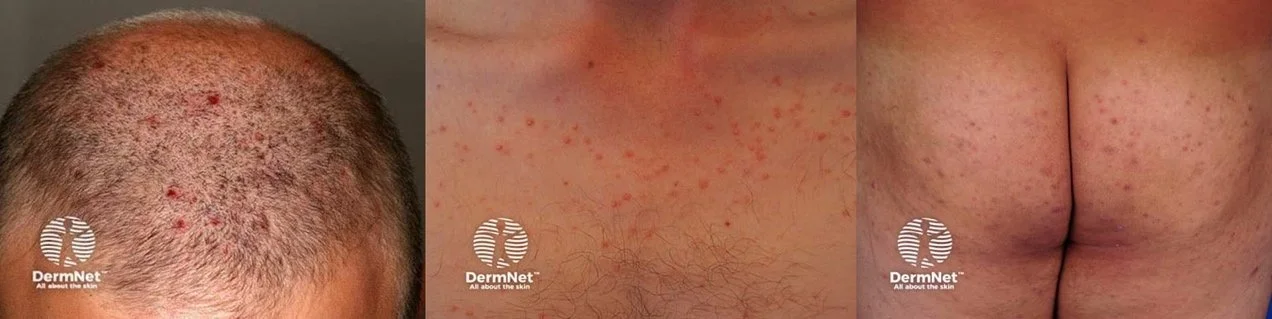
/ Image source : DermNet
- Back
The back has a high density of sebaceous glands, leading to increased oil production. Sweat, heat, and limited ventilation from clothing can disrupt the follicular
environment.
Residual hair products or wet hair resting on the back may further increase moisture and trigger flare-ups.
- Buttocks
The buttocks are often warm, humid, and exposed to prolonged pressure and friction.
What is commonly called "butt acne" is usually folliculitis. In more severe cases, it may develop into a furuncle (boil) or, rarely, a carbuncle.
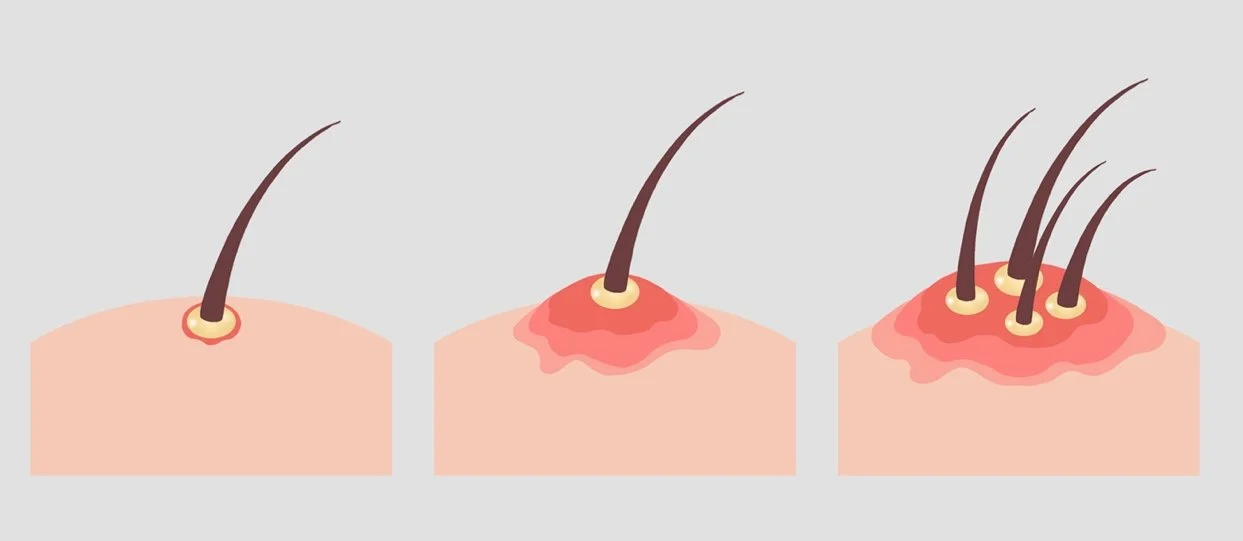
/ Image source : Dr Peng SkinWellness
Why Treatment Sometimes Makes Things Worse
When folliculitis keeps coming back, it’s tempting to do more—more antibiotics, acids, and scrubbing.
But sometimes, more just makes it worse. Several factors may be at play.
- Microbiome Imbalance
If the issue isn't bacterial but related to yeast or microbial imbalance, repeated antibiotic use can further disrupt the skin's ecosystem—allowing yeast to overgrow.
- Over-Treatment
Trying to "clean things out" with frequent acids or exfoliation may end up irritating the follicle instead, making inflammation worse rather than better.
- Skin Barrier Damage
When the skin is constantly treated, scrubbed, or stripped, its barrier weakens.
The result is skin that becomes more reactive, slower to heal, and easier to flare — creating a cycle of ongoing irritation and recurrence.
When Should Medical Evaluation Be Considered?
Professional evaluation is recommended if folliculitis:
- recurs repeatedly in the same area
- gradually spreads or worsens
- becomes increasingly painful
- develops deeper nodules or lumps
These signs may indicate inflammation that extends beyond superficial folliculitis.
Recurrent folliculitis may sometimes be associated with systemic factors such as abnormal blood sugar levels, immune changes, or medications that affect immune balance.
The brain–skin–gut axis highlights how stress, gut health, and the immune system are closely connected. Sometimes, the skin is simply where this internal imbalance becomes visible.
The Core Principle of Treating Folliculitis
Effective management of recurrent folliculitis is not only about eliminating germs.
More importantly, it involves:
- restoring the microbial balance around the follicle
- improving the loc
References:
- DermNet
- Dr Peng SkinWellness
